
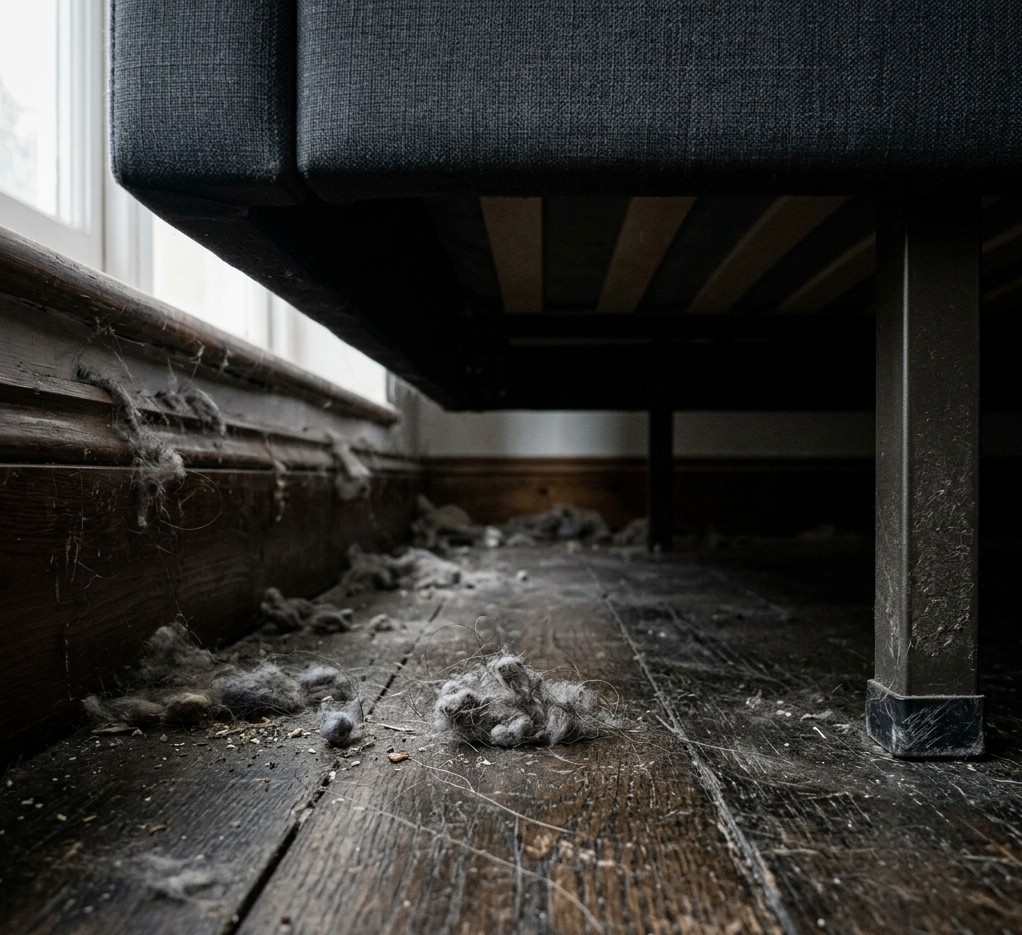
There is a moment – usually when you drop something small and watch it roll into the darkness beneath the bed frame – when you are forced to confront what you have been very deliberately not thinking about. The glimpse is brief, but it is enough. What you see in that half-second is not simply dust. It is an entire civilisation. A lost continent of fluff, approximately four socks that appear to have been there since 2019, a paperback you filed a missing report on, and what is almost certainly – though you refuse to confirm it – a cough sweet still in its wrapper. Under the bed is, in the grand tradition of all the best horror films, the place where things go and are never spoken of again. The medieval cartographers had it right: here be dragons.
The good news is that cleaning under your bed is considerably less horrifying in practice than it is in anticipation – provided you approach it methodically, with the right tools, and without the rookie error of having a proper look before you are genuinely prepared to deal with what you find. Here is how to tackle it properly, from first principles to finish.
What You’re Actually Dealing With Down There
Before we get practical, it is worth understanding what the under-bed environment actually consists of, because “a bit dusty” dramatically undersells the situation.
What accumulates under beds is primarily a combination of shed skin cells – the average person produces roughly 30,000 to 40,000 of them per hour during normal activity – pet hair where applicable, textile fibres from bedding and clothing, and settled indoor airborne particles that drift downward when a room is not regularly disturbed. This mixture forms the primary food source for dust mites: microscopic creatures present in virtually every home, whose waste products are among the most potent common allergens associated with asthma, eczema flares, and disrupted sleep. They are not dangerous in themselves, but they are the reason that the under-bed falls squarely into the category of things that genuinely affect your health rather than simply your conscience.
The lost socks and forgotten books are the visible, almost charming layer. It is what you cannot see that gives this particular corner of the home its real claim on your attention.
Getting Your Kit Together Before You Commit
The single biggest mistake people make when deciding to finally clean under the bed is starting without the right tools and abandoning the job halfway through because they cannot reach the far corner. Commit to the kit before you commit to the clean.
You will need: a vacuum cleaner with a long, flat extension hose attachment – most modern cylinder vacs include one, and if yours does not, they are inexpensive and genuinely transformative for this specific task; a flat-head microfibre mop or extendable flat mop for anything the vacuum leaves behind; a supply of microfibre cloths; a bin bag for the archaeology phase; and a floor cleaning solution appropriate for your floor surface. A head torch sounds like overpreparation but is, genuinely, useful for identifying what you are dealing with in the far reaches before you commit to extracting it.
Lay everything out before you start. Once you have begun, you are committed until the end.
To Move the Bed or Not – That Is the Question
Moving the Bed: When It’s Worth the Effort
If you have not cleaned under the bed in more than three months, or if you are doing a seasonal deep clean, moving the bed is the correct call and there is really no arguing with it. There is no substitute for full access when the build-up is significant.
Before you drag anything across the floor, take a photograph of the current position – particularly relevant in London bedrooms where the bed has been wedged at a very specific angle between a radiator and a wardrobe that took twenty minutes to achieve and will never be recreated by instinct alone. Slide rather than lift where the floor allows, and protect wooden or tiled surfaces with a folded towel under the frame feet if there are no castors.
Working Around It: Tools and Technique
For maintenance cleans between proper deep sessions, moving the bed is unnecessary – and on a Wednesday evening after work, frankly unrealistic. A flat vacuum attachment on a full-length hose will reach the majority of the floor area from either side. A flat microfibre mop on an extendable handle covers the rest, including the far wall edge that the vacuum cannot quite reach. Work in deliberate strokes from the far edge pulling towards you, so you are always drawing debris into accessible territory rather than pushing it further into darkness.
The Deep Clean in Sequence
With the bed moved and your kit assembled, work through the following in order – the sequence matters more than most cleaning guides admit.
Start with what you might charitably call the archaeology: before any cleaning begins, retrieve everything that does not belong on the floor. Resist the urge to triage as you go, because that way lies a forty-five minute detour involving the book you forgot you owned. Everything into the bin bag first; sort it later when you are sitting down.
Follow this with a thorough dry vacuum of the entire floor area, working in overlapping passes and paying close attention to the edges where the floor meets the skirting board – this is where dust compresses most densely and where mite activity concentrates. Empty the vacuum before you start if it is anywhere near capacity; suction drops sharply with a full canister and the whole exercise becomes largely symbolic.
Next, follow the vacuum with a flat microfibre mop lightly dampened with your floor cleaner. The word “lightly” is doing real work in that sentence – excess moisture under a bed, where air circulation is minimal, takes considerable time to dry and creates exactly the damp conditions that mould and mildew require to establish themselves.
Finally, leave the cleared area for at least twenty minutes before sliding the bed back, and consider repositioning it very slightly if the space allows. Even a few centimetres in either direction disrupts the established dust accumulation patterns and meaningfully slows future build-up.
The Case for Sorting Your Under-Bed Storage Properly
If you use the space under the bed for storage – a perfectly sensible use of scarce London square footage – the type of storage you choose will determine how manageable cleaning becomes over the long term.
Open cardboard boxes and loose items sitting directly on bare floor are, from a cleaning standpoint, a consistent problem. They are impossible to vacuum around, they trap and compress dust, and they require complete removal every single time you want to clean properly. Low, flat, lidded storage containers on castors or short feet are significantly better: they slide out in a single movement, the floor beneath them remains accessible, and their contents are protected from the dust you are actively trying to remove.
If you are storing anything fabric-based under the bed – spare bedding, out-of-season clothing – keep it in sealed bags or proper storage boxes rather than loose. Fabric sitting open under the bed is simply an extension of the dust mite habitat you are working to reduce.
How Often Should You Actually Do This?
The honest answer is more often than you are currently doing it, and less often than the level of anxiety around it implies.
For the full move-the-bed deep clean: every two to three months is a sensible target for most households, reducing to monthly if you share your home with pets that shed, have allergies to dust mite allergens, or have asthma in the household. For the maintenance pass using the flat attachment and long-handled mop: once a fortnight is achievable and makes a genuine, measurable difference to bedroom air quality – relevant given that most people spend approximately a third of their lives in the room.
Setting a recurring reminder rather than waiting until the situation demands emergency action is, without qualification, the approach that actually works.
Keeping It Under Control Between Deep Cleans
The under-bed does not deteriorate uniformly. The majority of build-up happens at the edges and corners, where airflow from the room is lowest and settled debris compresses most readily. A two-minute pass with a flat attachment along the perimeter every couple of weeks – not even pulling the vacuum out specially, just using it at the tail end of a regular floor clean – prevents the kind of dense accumulation that makes the full deep clean feel so forbidding each time you approach it.
One further habit worth building: reduce what lives on the floor immediately around the bed. Clothing piled at the foot of the frame, bags leaning against the side, shoes stored loose rather than in a rack – all of these increase the volume of textile fibres migrating under the bed with every footstep and every movement of the duvet. Less on the floor around it means less finding its way beneath it.
The under-bed is never going to be the favourite item on anyone’s cleaning list. But tackled as a consistent habit rather than an annual reckoning with your past choices, it is entirely manageable – and rather better for you than the alternative of leaving the dragons entirely undisturbed.